The works left behind under the title Caravanserai by the late Hessam Rezaei offer an opportunity to observe painterly gestures reminiscent of Expressionist artists—gestures that, over recent decades, have re-emerged in neo-expressionist forms with renewed relevance and application, though not with the same public notoriety as in the past. It appears that German artistic traditions, as an underlying backdrop, played a significant role in shaping the characteristics of Rezaei’s painting.
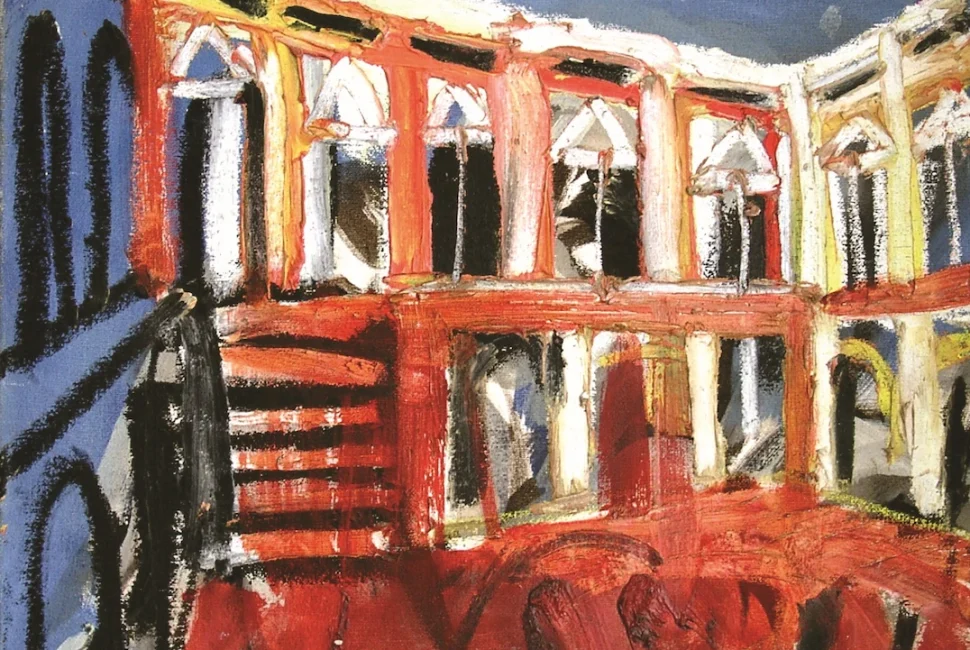
His intense inclination toward the vigorous movement of the brush and the swirling application of dense patches of color across his canvases, the arrangement of highly contrasting tonalities which, despite their freedom and fluidity, are handled with remarkable sensitivity, as well as distortions, abbreviated lines, and simplified forms, collectively construct a highly charged expressive language. These images seek to reveal the latent forces embedded within traditional architecture or Iranian landscapes, ultimately shaping a visual expression guided by the painter’s exploratory vision.
Rezaei can be considered a painter influenced by Neo-Expressionism. However, his inclination toward landscape painting and the experimental dimension of his practice gives this influence a selective direction. Beyond the general traits of Expressionism, his work can be situated among artists who have moderated Expressionist tendencies toward landscapes and everyday scenes, relying primarily on color modulation and brushwork to reconstruct new worlds and meanings within their imagery. Leon Kossoff and Frank Auerbach are among such artists; indeed, their thick, impasto-based application of paint bears notable similarities to Rezaei’s practice in this context. Both artists drew upon the achievements of Expressionism in service of their own artistic choices and ideas, thereby emphasizing the individual painter’s interpretive approach to reconstruction—a quality also evident in Rezaei’s Caravanserai series.
He brings a deserted building with traditional architecture to life, creating convincing forms through his painterly skill. One of the painter’s defining sensibilities lies in his refusal of verbosity; the elimination of ornamentation and “identity-signifiers” reveals his deep conviction in a pictorial form capable of sustaining a meaningful presence without recourse to peripheral embellishments. The breadth of his experimentation lends a shared motif a range of divergent meanings and effects. This constitutes a significant aspect of the present body of work, suggesting that he subjects architectural form to a process of visual interpretation and inquiry. In one work, the viewer encounters layered chromatic masses rendered through subtle brushwork and patient, almost empirical attentiveness, as though the artist were probing the angles of the structure and reconstructing it through contemplative observation.
In another work, he concentrates on linear structures and formal relationships, articulating the architectural form with broad, dark lines against a richly textured ground. By developing a system of rhythms and reflecting the structure in water, he is able to extend these formations across the surface of the canvas, arriving at a purer articulation of symmetry and pictorial surface.
In another work, he adopts a Fauvist approach, contenting himself with only a few lines and patches of color, as though, upon this luminous ground, he conjures the spirit of a structure. In yet another painting, he sets red and green into a strange confrontation, while yellow tonalities and shadows lend the building a mysterious presence. The painter’s dynamism in arriving at new interpretations and visual perspectives dispels any suspicion of repetitive production within these images. His flexibility toward forms that emerge during the process of execution—under the shelter of his guiding idea—assists his movement toward other horizons and periods, gradually dissolving intertextual influences within this evolving trajectory.
The presence of such influences—manifested both subtly and overtly—neither guarantees value nor detracts from it. Yet part of what continues to live on as an artwork emerges independently from the mere sum of these influences. No artist exists without engaging with the art that precedes them or that of their own time. What truly matters is the artist’s internal refinement and assimilation of both conscious and unconscious influences, transforming them into works that step out from the shadow of their sources and attain an autonomous life. Many of the defining characteristics that have taken shape in Rezaei’s works retain those references only as initial stimuli or points of departure.
An example of such influences can be seen in the composition and placement of the building within the frame, which recalls works by Anselm Kiefer. In Kiefer’s paintings, the vanishing point often lies near the center, and the rhythm of surrounding columns and windows draws the viewer into the depth of the image. Portions of the sky and the upper and lower planes of the canvas are arranged symmetrically. In Kiefer’s work, the combination of intense perspective, symmetry, and monumental scale conveys a metaphysical, almost hyperreal presence of the building, leading the viewer toward a grand and enigmatic depth aligned with his romanticized view of history.
In Rezaei’s works, however, this compositional approach transforms into a structure that enables him to impart multiple interpretive layers to the building, while simultaneously allowing surfaces and colored forms—independent of the perspectival framework—to create a performative tension across the canvas. A shared feature between the two approaches is the manner in which the viewer’s gaze is guided by the side walls and the symmetry of the composition, evoking a ceremonial or ritual-like sensation. At the same time, this symmetry resonates with conventions of Eastern pictorial traditions, although in certain works the breaking of this symmetry through the use of light and shadow generates visual dynamism and tension.
Within this body of work, however, several aspects might have contributed more effectively to the paintings’ impact. First, the works are both small in scale and nearly uniform in size; within this modest dimension, it is as though a cry has been compressed into a whisper—an expressive potential seemingly withheld from both the works and their audience. Another point concerns the framing of the paintings, which—despite reflecting Rezaei’s distinctive and innovative mode of presentation—encircles the fervent inner essence of the images with a delicacy that does not entirely correspond to their intensity, further enclosing them within dual light and dark borders.
In his subsequent series, titled Abyaneh, Rezaei had the opportunity to draw upon the achievements of the Caravanserai series in order to develop a more personal painterly language—an effort realized only in certain works rather than throughout the entire series. Beyond the elevated aerial view of the city—an approach also observable in works by Gerhard Richter—his engagement with the subject was marked by a lively and renewed sensibility. As in the previous series, a shared subject served as a vehicle for applying diverse methods and generating a wide spectrum of meanings for an Eastern city. Yet Rezaei did not pursue this path fully; he abruptly turned his attention toward iconographic and religious imagery, leaving his narrative unresolved and his intentions ultimately unknown.
The Spirit of a Building; A Note on a Collection
Herfeh: Honarmand / Issue No. 7
Dariush Khademiبرچسبها:
Iranian Contemporary Art
فرم و لیست دیدگاه
۰ دیدگاه
هنوز دیدگاهی وجود ندارد.