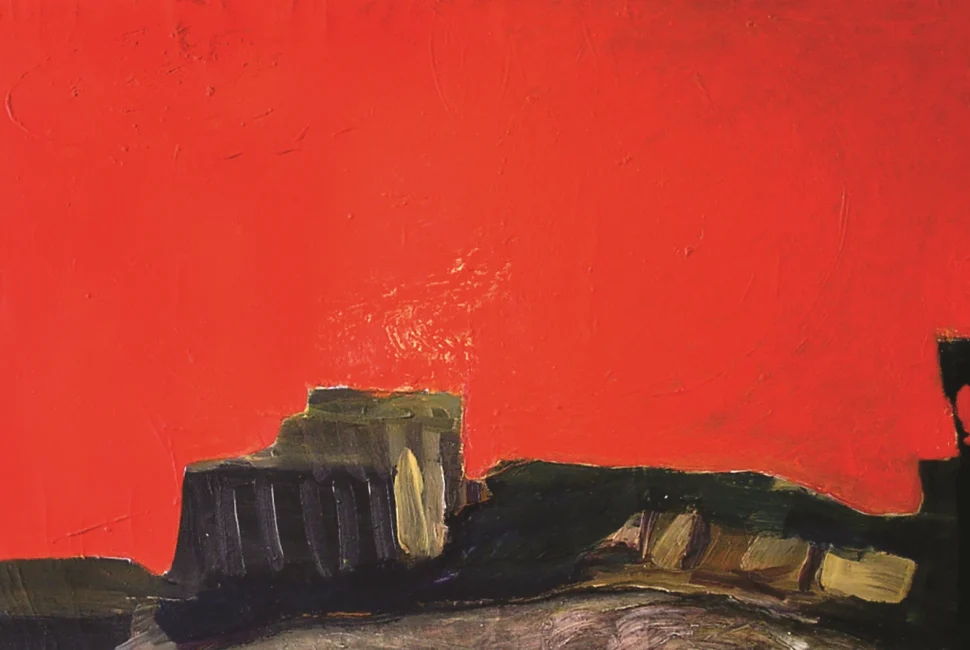
More than fifteen years ago, during a visit to an exhibition at Sabz Gallery, I encountered a series of extraordinary works charged with a remarkable energy that immediately captivated me. When I became acquainted with the painter of these works—an acquaintance that later grew into a valuable and unforgettable friendship—I realized that his calm, untroubled demeanor, along with the composure evident in his conduct and practice, bore little outward resemblance to his works.
It seemed as though he had merged the inner substance of his creations with a restrained external energy and then gave it visual form. His paintings were filled with intense, vibrant, and expansive colors, set alongside dense textures that were sometimes even scraped away by the artist’s own hand. These elements were arranged in striking contrast, forcefully asserting the abstract foundation underlying his paintings. While viewers initially encountered abstract compositions—reminiscent of Abstract Expressionist works—the final image often revealed itself as a landscape imbued with a peculiar nostalgia, as though the artist, emerging from a profound and enigmatic sorrow, had begun layering colors and textures. It was as if Hessam had embarked upon his paintings driven by an inner excitement entwined with deeply held emotional tension.
In later periods, he turned toward Iranian architecture. The city of Yazd and its architectural character became the catalyst shaping his works during that phase. The paintings from this period reflect the complex cultural condition of a country affected by cultural amnesia. Within these historical structures, there is no trace of human presence. Even when figures appear, they are devoid of concern—mere fleeting shadows whose passage leaves no lasting impression on the viewer.
His paintings of Abyaneh, forming another significant group from his years of residence in Germany, likewise convey a direct reference to the height of his historical isolation and his sense of estrangement in a cold foreign land, alongside a longing to return to his sunlit homeland. This yearning seems to have shaped the entire concern with personal and authentic identity within his paintings.
Although Hessam possessed a refined and accomplished skill in figurative drawing, and despite the foundation of his academic training at one of Berlin’s most reputable universities being rooted in the study of the human figure, he largely avoided human forms in his more personal and original works. It seems that, during certain periods, he distanced himself from humanity, seeking his truer and more abstract form within nature. Yet even the trees that appear in his paintings strongly evoke human figures—figures that, much like the artist himself, seem to have withdrawn and concealed themselves within the embrace of nature.
Ultimately, a few years before his death, he left his residence in Germany and returned to his homeland, hoping to free himself from the estrangement and isolation he had experienced abroad, and to find comfort in the colors of Iran. A great painter such as Hessam was deeply influenced by his inner physical condition, shaped in part by chronic high blood pressure that had accompanied him for many years. His intense and fiery palette appears to reflect the painful sensibility of an individual burdened by both the physical strain of his condition and by emotional sorrow and exile. The fusion of these pressures brought forth works that allowed him to momentarily transcend his solitude while awakening a deeply empathetic response in the viewer. Regrettably, neither his return nor his passing succeeded in dispelling this profound loneliness.
I recall that several years ago, I discussed with him the “death of the author” and the emergence of immediacy between the artwork and its audience. We both came to believe that the artist’s death could mark the beginning of a new life—one that would play a significant role in shaping the inner evolution of his work.
I, along with many painters and friends who had closely witnessed his works and traced his artistic progression through his paintings, believe that we have lost a truly great painter. We had hoped that, at the very least, through coherent and well-structured cultural planning, institutions such as museums, publishing houses, and other art-related organizations would more fully develop and present the true and inner identity of an artist like Hessam Rezaei—figures of his caliber being exceedingly rare—through exhibitions, acquisitions of his works, and publications. Unfortunately, such recognition often proves unattainable without the networks and connections established during the artist’s lifetime.
Hessam, an individual who managed his work independently and without reliance on external power structures, was denied by his untimely death the chance to let museums and other artistic institutions in our country recognize, through the very quality and integrity of his work, both its profound merit and elevated spirit, and the care it truly deserved.
فرم و لیست دیدگاه
۰ دیدگاه
هنوز دیدگاهی وجود ندارد.