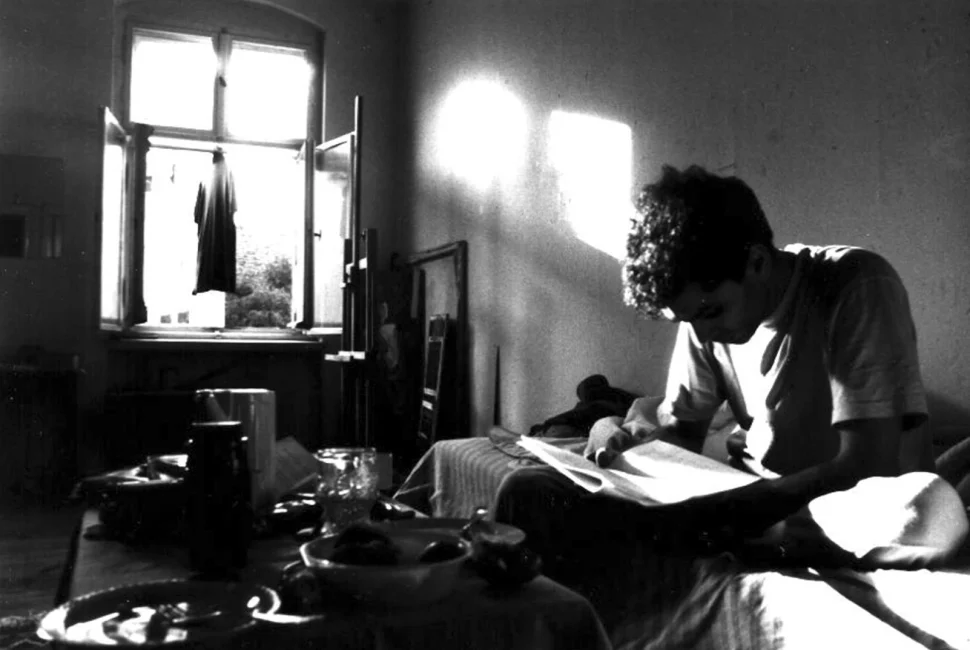
This interview was conducted ten years earlier and was first published in Issue No. 12 of Shabab magazine (Azar–Dey 1373 [December 1994–January 1995]).
Mr. Rezaei, thank you for giving us your time. Please tell us about yourself and how you came to painting.
Until 1979, my engagement with painting was limited, but after the Revolution—around 1980 or 1981—I began to pursue it more seriously. Before that, I worked independently, without formal instruction, simply painting for myself. During those years, I decided to follow painting more earnestly; I had always wished to devote myself to it more fully. After the Revolution, I became acquainted with several painters and attended their classes, including those of Ms. Samila Amirebrahimi, Mr. Mousavi, and Mr. Aghdashloo. I also worked for a period with Hassan Safa, who later lost his life in a car accident in France. In my opinion, his death was a great loss to the Iranian art community. I was also familiar with Mr. Habibpour, Alkhas, and Sherveh, though only from a distance and without close personal relationships. In the joint classes of Ms. Amirebrahimi and Mr. Mousavizadeh, we focused on portrait drawing, still life, and similar subjects.
How did you decide to go to Europe to continue your studies?
In 1984, I went to Germany with the aim of continuing my studies in painting. It was not an easy situation, as I went abroad without any support. I’m not sure whether these details are necessary, but in any case, I entered Germany on a tourist visa. After six months of language study, I went to West Berlin to take the entrance examination for the Berlin University of the Arts (HDK)[1]. After making inquiries, I realized that I needed to submit a selection of my works in order to participate in the entrance exam. At first, I did not know exactly what they were looking for. I had defined three working themes for myself: portrait, landscape, and still life.
At the Berlin University of the Arts, two entrance examinations in painting are held each year, although in some disciplines candidates are allowed to take the exam only once a year. From the moment I arrived in Berlin, my goal was to enter the art university and learn. After three years, my works were finally accepted on my sixth attempt, and I was able to enroll at the university.
What were you doing during those three years?
During that period, I attended guest classes at the same faculty every day and worked on anatomical drawing. Gradually, I realized that this type of drawing helps a person find their direction.
Perhaps it would be useful to explain the conditions for admission to the university and how the entrance examination is conducted.
First, applicants must submit a selection of drawings along with their application. If the drawings are accepted—which is effectively the most decisive stage—they are invited to sit for the entrance examination. The examination lasts five days: the first day consists of a written test; the second and third days are devoted to drawing; the fourth day is dedicated to painting; and the fifth day involves an oral examination in the form of an interview. On that same day, a committee convenes and announces the final decision.
Who are the members of this committee?
Mainly professors of painting, sculpture, and graphic design.
Please explain more about these five days of examinations.
The first day’s exam is personal and focuses on the applicant’s views on painting—why they paint, what their goals are, and similar issues. Essentially, the applicant must write about themselves, their work, and their future objectives.
On the second and third days, applicants must draw based on various subjects. Sometimes the committee decides to take the candidates into the city or other locations to draw. On the fourth day, applicants must produce a painting. At this stage, the committee usually constructs a large setting in the middle of the hall—such as a still life arrangement draped with fabric or a live model, sometimes arranged like a small room—and applicants stand around it and paint.
On the fifth day, candidates are called into the committee room one by one, and their entire body of work is reviewed. Each committee member asks questions, usually about the works or about the candidate personally. At the end of that day, the list of accepted candidates is announced.
Typically, each semester about 450 painting applicants from different cities and countries submit their portfolios. The proportion of foreign applicants to German applicants is roughly equal, perhaps even higher. From these 450 portfolios, about twenty to twenty-five are selected and invited to participate in the five-day examination. Approximately five are eliminated during the exam, and the rest are accepted.
Does this mean that only about twenty students are admitted each semester?
Yes. If the works are particularly strong, sometimes as many as twenty-five students may be accepted. Occasionally the number is lower, but it never exceeds twenty-five.
Please explain further about the type of works submitted for the entrance examination.
Someone whose work is extremely precise and strictly realist, focused mainly on meticulous execution, would most likely not find a place at this university. What they are looking for is something fresh—an original idea. At the initial stage, technique is not important at all. What matters is the ability to express or reveal a clear trajectory in the work—an issue that engages the applicant and raises questions for them. By examining the drawings and colored works, the committee members try to infer the candidate’s personality. It should also be noted that the committee’s composition is diverse. A strong portfolio is one that approaches both itself and painting with honesty.
For instance, at one point there was an exhibition of Giacometti’s works in Berlin. During that period, most applicants’ drawings suggested that they were essentially producing small Giacomettis of their own.
Setting the entrance examination aside, how does the teaching and study system function?
After passing the entrance examination, the selected group spends two semesters studying drawing under two professors. These two semesters, known as the foundation semesters, place their primary emphasis on drawing. At present, many students who begin their studies tend to place less importance on drawing and prefer to immediately present something new or produce modern work. Nevertheless, there are still students who are genuinely interested in drawing. Despite all this, drawing remains one of the major and compulsory subjects at the university, and every student must obtain formal approval from the drawing instructor.
What subjects do students usually draw?
The drawings are mostly focused on anatomy, still life, and landscape.
How long does the course of study at this university last, and what kind of system does it follow? Is it credit-based?
It does not follow a credit-based system. The program lasts six years and is predominantly practice-oriented. There are also compulsory theoretical courses, but the primary emphasis remains on practical studio work.
In Iranian universities, according to the curriculum established by the Cultural Revolution Council, the bachelor’s program consists of approximately 145 credits and typically takes between four and six years to complete. These credits largely consist of painting and drawing courses that must be completed.
At HDK, students are also required to attend and successfully complete various workshops. By the end of the program, students must obtain a total of twelve approval certificates from professors in different fields—six from theoretical courses and six from practical and technical courses. For example, students must obtain approval from a drawing instructor or from graphic arts courses, where they select two areas from several graphic disciplines, such as lithography, stone printing, metal printing, silk-screen printing, or technical workshops such as metalwork, bookbinding, welding, and synthetic materials.
Is completing these courses compulsory?
No, they are elective. There are numerous facilities available, and students can obtain the required number of approvals according to their personal interests. I chose lithography and silk-screen printing, and I also worked somewhat in metal printing, which was entirely my own choice.
The theoretical courses include various classes in which professors discuss different subjects, and these are also optional. The structure of theoretical classes depends on the individual professor. One professor may believe that attendance at all sessions is compulsory and that written work is unnecessary. Another may say that attendance is not mandatory but that students must prepare a written report on the discussed material. Others may require students to attend classes and give presentations.
What subjects do these theoretical courses cover?
That depends on the professor’s area of focus.
For example, in Iranian art faculties, courses such as Art History and the History of Painting are compulsory. How is it at HDK?
They are not compulsory at all. Attendance in theoretical sessions may sometimes be mandatory, but the structure does not require students to study specific materials and then be examined on them. For example, during a particular semester, a professor might lecture on Romantic painting; students may attend the class during that term and, if they wish, obtain an approval certificate from that professor.
In Iranian universities, there are also general courses such as Persian literature, foreign languages, and similar subjects. Did you have courses of this kind at HDK?
Not in that form. Our general courses consisted of the approval certificates we obtained from various technical workshops, such as printmaking, color theory, and related fields. The theoretical courses followed the same approach. For example, if you were interested in Schiller’s aesthetics, you would attend classes examining that perspective. As an example, in the previous semester, Nietzsche’s ideas were particularly popular.
How are the practical workshops conducted, and from which year does serious painting begin?
During the first year—semesters one and two—the entire selected group studies under two designated professors and completes the foundation courses I mentioned, primarily drawing. After the second semester, an examination is held. In fact, there are no regular examinations during the other semesters. After this stage, students may choose one professor from among those teaching at the university by presenting the works they have produced up to that point. If the professor considers the work to fall within the framework of their artistic perspective—and depending on the capacity of the class—the student is accepted and may begin working in that professor’s studio.
Each professor, depending on their popularity, usually teaches two to four classes. For instance, one of the professors who attracts many students is a Syrian painter named Marwan.
At this stage, students select a professor either because they appreciate that professor’s work or because they are drawn to the atmosphere of the class. For example, I do not like all of the paintings of my professor, Karl Oppermann, but I was more interested in the atmosphere of his class.
In my view, students do not actually learn technical skills from their professor at this stage. The professor mainly expresses opinions about the paintings and serves more as a guide to the student. In other words, technical instruction is not provided directly by them; techniques are taught in practical workshops. Of course, some professors attempt to exert strong influence over their students, meaning that the student produces work clearly shaped by the professor’s perspective. In such cases, it is sometimes possible to recognize a particular professor’s style in the work of their students. My professor functioned more as a capable mentor than as a conventional instructor.
At first, I believed that at an art academy one would be taught painting from the very beginning. This is not the case. At HDK, students are free to work according to their own inclinations, although they must pass through several evaluative stages. In the fourth semester, all students who entered together exhibit their works and undergo an examination. However, to participate in this examination, students must present a number of approval certificates related to other courses.
The next examination takes place in the tenth semester and is considered the final examination. After successfully defending the thesis, if the relevant committee approves the body of work, the student is invited to the Meisterprüfung (Master-level examination), which is essentially comparable to a ceremonial conferral of the Meister title. Some candidates fail and therefore do not receive this title. I am currently at this stage. I have completed my thesis, and in January 1995, together with others who have passed, we will hold a group exhibition as part of receiving the Meister title.
What would be the Iranian equivalent of this degree?
I don’t know precisely, but considering its six-year duration, I think it would roughly correspond to a Master’s degree.
Apart from painting, which other disciplines are taught at HDK?
At this university, eleven disciplines are taught: Painting, Sculpture, Architecture, Graphic Design, Industrial Design, Fashion Design, Music, Art History, Art Education, Audiovisual Communication, Socioeconomic Communication (Advertising), and Stage Design.
During your studies at the university, which approach did you prefer? Who influenced you the most?
I was influenced by various painters, mainly Matisse, Van Gogh, and Picasso. These painters occupied my attention for a long time. After that, I became particularly interested in the works of Soutine, which I still love, as well as Modigliani. Perhaps it would be easier to ask which painters I did not like.
For some painters, certain figures remain on the horizon of their imagination. What about you?
Munch has always been an important figure for me.
Moving on, could you tell us a bit about your exhibition activities?
In Iran, I have had two solo exhibitions so far. I also participated in last year’s biennale. In 1992 (1371 in the Iranian calendar), I brought some of my paintings to Iran for the first time, and in September of that year I was able to hold an exhibition at Sabz Gallery. That exhibition was a very positive experience for me and was well received.
The second exhibition, in my opinion, was of much higher quality than the first; however, it did not receive the same level of attention as the 1992 exhibition. This may have been due to limited promotion or the short duration of the exhibition. As for the biennale, I was not present myself, so I am not sure how it was organized.
How about in Europe?
I have had many exhibitions there, mostly group and student shows. Last April, I held a solo exhibition in Sweden, and I also organized an exhibition with three of my classmates at Berlin City Hall.
I also participate in the annual student exhibitions called FBK. As long as I am a student, I can participate individually, but afterward I would need to participate as part of a painters’ group.
[1] HDK: Abbreviation for Hochschule der Künste (University of the Arts) in Berlin. In 2001, the name was changed to UdK (Universität der Künste, Berlin University of the Arts).
فرم و لیست دیدگاه
۰ دیدگاه
هنوز دیدگاهی وجود ندارد.