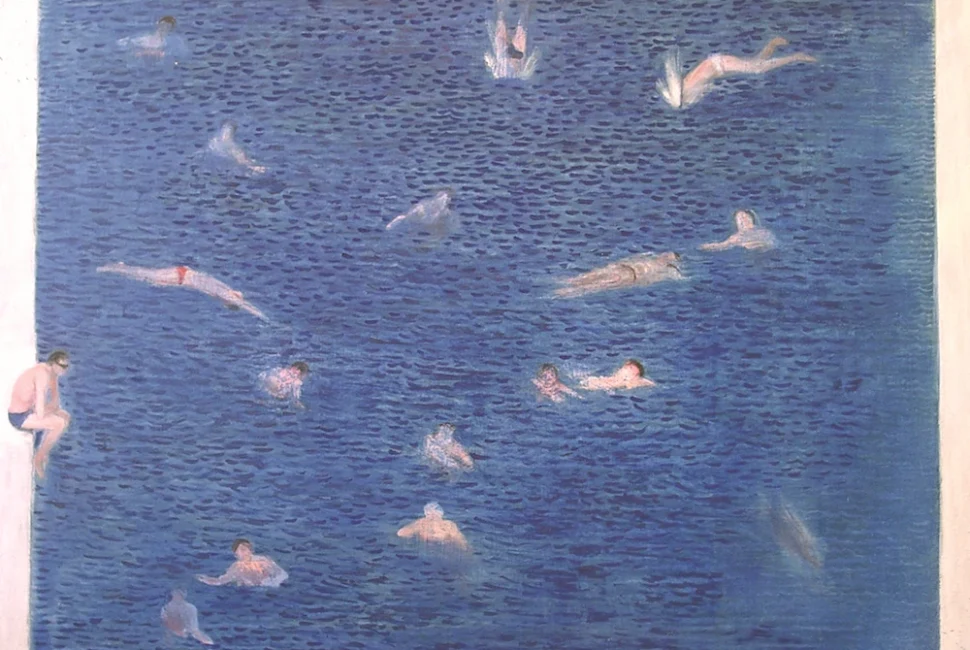
At the recommendation of friends, and in view of the growing interest in Hessam Rezaei’s work in recent years, I have attempted to review his works, which are not widely available in Iran. His works are grouped into three series of images, which, according to those close to him, were created during his repeated travels between Iran and Germany. The first group is entirely experimental, often informed by the avant-garde sensibilities of a visual inquirer. The second comprises landscapes that primarily attest to his technical command and maturity. The final group, though less cohesive, reflects his attempts to retrieve what he had lost while living far from his homeland and loved ones.
An artwork comes into being in accordance with the artist’s nature. The relationship between an artist’s life and their work is a necessity we may call true authenticity. Any cultural creation that is connected to the inner and outer foundations of its creator—and capable of reflecting a part of them—deserves recognition and reverence, regardless of personal taste or judgment, for its claim to an unmediated narration of existential truth. Many paintings and sculptures are executed at the highest level of technical and formal refinement, yet precisely because they are incidental or imposed upon their creators, they are ignored—or must be.
There are image-makers in their early twenties who depict dismembered bodies, scenes of torture, mutilated forms, and often sexually deviant or diseased figures—yet I have known them since they were seventeen, and no aspect of their personal lives has ever been intertwined with such imagery or atmospheres. I deliberately use the term “image-maker,” for when a person does not move beyond mere reproduction of images from video clips, magazine photographs, or, at times, artificially induced excitements from chemical or plant substances—and attempts to construct images from them, such fabricated outputs cannot bear the name of art in the sense of being an expression of the artist’s tangible existence.
I do not admire Hessam Rezaei for his so-called “Iranian” colors—his colors are not Iranian at all—nor for his calm and quiet spirit, which I never had the chance to witness while he was alive, nor for his diligence, which, after all, is the duty of any true artist. I admire him solely because he learned painting with patience, and because a deeply interconnected chain of continuous experiential learning runs through his work. It astonishes me that an academy could have nurtured such an artist.
Hessam Rezaei’s art is a product of Northern European academism, marked by the paradox that, during the middle phases of his artistic life, he would occasionally return to painting with heartfelt engagement, refusing to let academic conventions dominate his work. Yet the landscapes and architectural forms he depicts from Iran still bear the imprint of a solid Northern European academic style, evoking Munch’s use of color and, even more so, the German new wave of abstract expressionism. He did not live long enough for us to see how he might have absorbed this academism into a more personal, intimate framework, or whether he could have transcended its structures. Nevertheless, the works that remain stand among the rare examples of an artist who mastered contemporary training at its highest level. In his work, deficiencies in composition, color, and other fundamental aspects have all but vanished—perhaps a testament to his relentless practice.
Across different periods, he explored every inclination that caught his eye. One painting from the Abyaneh series recalls Cézanne, with a comparable precision in composition; another, titled Niasar Fire Temple, with its uniform red, evokes painters such as Soutine. His caravanserais—arguably the most enchanting phase of his work—display a distinctly Germanic approach in rendering images that ultimately seek to appear Eastern. Setting aside all discourse, Hessam Rezaei understood color far more profoundly than most contemporary Iranian painters and presented it through abstracted landscapes.
He continues the tradition of contemporary landscape painting in Iran. Rezaei’s images may be seen as emerging from the trajectory of Yektai, Davood Emdadian, and Sohrab Sepehri; yet, in vision and outlook, they remain unbound by any of the preceding movements in Iran.
Among his works, figurative images—reminiscent of icons, religious tableaux, and historical saints—occasionally surface. I cannot say whether he felt a personal attachment to them, or whether his intentions remained within the bounds of formal exploration. Yet, when he paints such images, unlike his landscapes, he is no longer entirely free or unselfconscious; a certain density of emotion—whether positive or negative, I cannot say—appears to restrain him.
Because Rezaei, throughout his entire career, avoided pure abstraction and preserved elements of the external world as a narrative framework for communication, he emerges as an artist who understood the boundaries of abstraction in painting and employed it to serve freedom, openness, and the expansiveness of emotion—not merely as an intellectual tool to restrain the viewer’s formal expectations in the history of art. Put differently, had he presented these same dense, rock- and tree-like colors under any title other than “landscape,” or cloaked them in grandiose, cultivated, or pretentious terminology, the sense of his absence would not have been felt in quite the same way.
Writing about a painter who has passed away is never entirely satisfying—a painter whom many now believe would have become one of the finest of his contemporaries, had he lived, though such claims are by no means certain. What matters is that the final decade of his artistic life produced a substantial body of work that, for many reasons, deserves careful attention and evaluation. Beyond all that has been said, his ability to convey meaning without reliance on drawing, using color alone, speaks to an ineffable energy and fervor within him—what we call art. In most cases, Rezaei succeeds in transmitting the intensity of his emotions to the viewer through an innate and often compelling visual language. This capacity to externalize his inner determinations distinguishes him from many artists whose paintings do not extend beyond technique, color theory, or—even at their highest refinement—compositional arrangement.
Whether he could have withstood the tastes of gallerists, collectors, and buyers, and remained steadfast on the path he had chosen, is something we will never know. What endures is the work he left behind—and before such beauty, these lamentations lose their voice.
فرم و لیست دیدگاه
۰ دیدگاه
هنوز دیدگاهی وجود ندارد.