Hessam Rezaei was born in 1960 in a religious family in Tehran. His loving father, mother, three sisters, and two brothers would always support him so, considering his passion for painting from such an early age, he entered a painting school. While studying there he attended the classes of various other masters as well and learned about the principles of design and simulation. During this period, which coincided with the exciting years of the beginning of the Iranian Revolution, Hessam was a jovial and energetic youth, and like most young people of that period, he was full of enthusiasm and idealism.
He participated in various social activities and wanted to use his art for the people but his fragile body and sensitive mind were very vulnerable to internal and external tensions to the point that he would sometimes get hospitalized. In the following years, social upheavals, the closing of universities, and the subsidence of the revolution made Hessam think of traveling abroad and continuing his art studies. But there were many problems. On one hand, separating from the family that he was very dependent on, and the huge cost of studying abroad for several years on the other hand would have been enough to make anyone give up this temptation, but this was not a fleeting desire. This little black fish had made up his mind and had to get to the ocean at any cost.
Eventually, with his family’s help, Hessam left for Germany to complete his studies. In an interview during his exhibition in 1992, Hessam said “In 1984, I went to Germany to pursue painting. Things were not easy. I went abroad without any support. I don’t know if it is necessary to say this but anyway, I entered Germany on a tourist visa and after completing a six-month language course to participate in the Berlin academy entrance exam, I went to West Berlin.”
Hessam spent some time learning German and painting portraits in Frankfurt to make a living. He eventually settled in Berlin and started painting seriously as a guest painter at the Berlin Academy of Arts. But that was just the beginning of his main problem: Being officially admitted to the Berlin Academy of Arts was an impossible hurdle that only Hessam’s will and love for art could conquer. Even though the quality of his works and what he had learned in Iran’s art classes up to that point painted him as a talented student, they couldn’t help him enter the Berlin Academy of Arts. The art education system in this academy required the student to have enough creativity and flexibility to learn. Hessam had to take six entrance exams in three consecutive years to be finally admitted officially to the academy in 1989.
A year later, Hessam wrote to me in a letter about his situation in the academy. “I passed the second semester successfully and had to choose a professor to spend the next ten semesters with, like all the other students. I chose Professor Opperman, not because I liked his work, but because of the atmosphere of his classes. Here my communication and relationship with other students is more important to me than just with the professor. Additionally, in classes, you aren’t taught enough to call them classes and the relationship between a student and his professor is more of a father-son relationship which can be summed up mostly to having short meetings with him. Everyone does whatever they want and this was completely contrary to my initial idea of an academy…”
Shortly after entering the university, he met a German art lover named “Rudolph Andrist ” who became interested in his work and tried to support him; An event that gave Hessam hope and encouragement, making life a bit easier. He wrote about this friendship in the same letter:
“During a short trip to Hamburg, I met a rich person who was very interested in painting and art in general. He wanted to see what I was working on and after returning from Hamburg he came to my house and saw my paintings. On the same day, he bought some of my works, but not at a high price. He paid a total of 500 D-Marks which was a very good help for a poor student like me. (The works were a still life and a city landscape of East Berlin and The Wall) Then he gave me a job in his secretary’s room where I could work two or three days a week. At the same time, he would regularly bring me painting orders from his friends, which as you know, I do not really agree with, but I haven’t rejected them yet because I do need the money.”
Rudolph Andrist wrote about this meeting in the introduction to a small pamphlet that was prepared from Hessam’s paintings after his death:
“I met Hessam for the first time in the twilight of an evening on the road from Berlin to Hamburg, looking for a ride. Along the way, Hessam spoke very passionately about his acceptance to the Berlin Academy of Art and his desire to continue his work… A few days after returning to Berlin, I met Hessam in his room in Wedding. After looking at his works, I chose a painting of the Berlin Wall and a still life. During dinner, I made my first purchase from him, which kept going on later as well. I also tried to look for buyers for his works among my friends and acquaintances…”
Missing his family and friends made Hessam start making regular trips to Iran from 1989 onward. It was during one of these trips to Iran that I saw him again after many years. He was well-dressed with a thin and elongated body. His green eyes and a warm smile elevated his face as usual but there was no sign of the vigor and joy of youth. He became quiet and rarely spoke. His calm and polite demeanor made him look more mature and aged than his real age.
Sometime before I saw Hessam’s exhibition at the “Sabz” gallery, he brought his collection of abstract works to my house to show me. There were about 40 to 50 small oil paintings. We placed them on the floor and looked at them, his works had completely changed. They were full of color, form, and energy and somehow reminded me of Van Gogh. Despite having no shapes they had an Iranian flavor to them. He then explained to me how much technical effort and how much nostalgia for Iran lies behind these small abstract works. He was very happy about holding his first exhibition in Iran soon.
Since then, he would come to Iran almost every year with a lot of his works, and while visiting his family and friends, he would use every opportunity to travel to different parts of Iran, looking at everything with great enthusiasm and making sketches for his works whenever necessary. I got to know more about Hessam during his subsequent visits and the short trips we had to Alamut and the outskirts of Tehran.
Hessam always had a palpable presence, one rarely mixed with any words. Something that would show simply through his eyes and smile due to the intense inner energy emanating from him. Sometimes you would feel all that silence came from a place of sadness but even if was, it was a persistent but gentle sorrow caused probably by living in a foreign land and his loneliness in his artistic works.
Like most artists away from home, Hessam was eager to connect with people and his surroundings to support and encourage everyone, but his faith and confidence let him look at the condition of the Iranian art market calmly and with patience, and only rely on his own work. He was confident and satisfied with his position and firmly believed in his work. Maybe that’s the reason why he never tried to prove himself to others. Although he valued friendship and human relationships, loved children and the elderly, and his family especially, he was lonely and never married in his short life.
Despite all the financial and emotional problems, Hessam managed to finish his studies at the Berlin Academy of Arts with an excellent degree in the following years and returned to Iran in 1994 with the intention of permanent residence. However, after dealing with professional and personal problems for a while he became doubtful regarding staying in Iran or returning to Germany. Holding three solo exhibitions in Iran which performed far below what he expected, not having the necessary space to work in, and maybe feeling lonely or alienated from the environment he so passionately came to Iran for had made him hesitant.
Still doubtful about staying, Hessam decided to teach painting at a university and start his life in Iran. In 1997, he officially became an academic faculty member of a private university and after becoming somewhat sure of his future in Iran, he went to the mountainous district of Tehran, Darakeh, to live and work in the workshop he found there. He had a collection of big unfinished works that he wanted to complete there. In the last days of his life, he was busy moving his equipment to this new place but he never got the chance to use this workshop. His heart finally gave out under all the physical and mental pressure on October 2nd, 1998.
Rudolph Andrist writes about Hessam’s spirit and character: There was a fire burning in Hessam’s soul. This fire from his love for painting gave him such strength that he could overcome any obstacles. Obstacles such as having to leave his family to live in an unfamiliar environment with a different culture, or poverty and the inability to afford his living expenses after such a long stay in Berlin. The last time we met he was full of plans for the future…
As the epilogue to the pamphlet about Hessam, Karl Oppermann, his well-known master, writes in a note: like most of his young compatriots, he wanted to learn Western art, or as some writers have said, the excited world art of the seventies. Therefore, he tried to refine the vegetative-decorative subjects of his country to perfect beauty in his works. But these visual simplifications were not enough for him and after many efforts, he discovered his personal abstraction of nature. These efforts can be easily seen especially in the unimaginable colors he used in a collection of paintings with a scale of up to 40×30 cm in size that he did after a trip he had to Iran. He brought many experiences with him from that trip. Hessam returned to Iran in 2015, a trip that was very important for him. This time he traveled on the route from Tehran to Isfahan to Shiraz and visited different old Caravanserais, swamps, city gates, Qanats, and clay walls covered by the fiery colors of the sunset sun which had a strong impact on him. In the aforementioned works, Hessam found his unique language and expression – a synthesis of content, color, and form. Despite such a satisfying achievement in his artistic work, he had an aura of sadness around him after his return to Germany. I used to think that this sadness was due to his family’s insistence on his return to Iran and subsequently having to abandon his circle of friends who encouraged him. But now I know that this sadness came from a place beyond that and was mostly related to dying and death. His complicated feelings and the internal conflict between suffering and pride or love and hate were never completely understandable to any of his colleagues. But his vulnerable physical condition and limited strength were understandable. These tensions affected his relationship with his supporters and friends on the one hand but on the other hand, they stimulated the creation of his unique expression, form, and color.
Artistic activities
From 1989 to 1994, Hessam participated in several solo and group exhibitions in Germany, including the Berlin Academy of Arts, the Berlin Film Academy, and the Evangelical Church in Berlin.
In August of 1992, he held his first solo exhibition with 37 abstract paintings of landscapes from Iran and Germany in Tehran’s Sabz Gallery which was a success. He also made notes and sketches on his trips to Yazd, Kashan, and Abyaneh which formed the basis of his paintings in Germany. Next autumn (August 1993) he returned to Iran and held his second exhibition at the Sabz Gallery displaying his big “Yazd Caravanserai” collection. In the same season, he participated in the second Iranian Contemporary Painting biennial.
In 1993, Hessam held a solo exhibition at Lövgren Gallery in Gothenburg, Sweden, featuring the same works, including the Caravanserais. In 1995, for an exhibition in Arya Gallery, he added a few landscape works from Abyaneh to the Caravanserai collection. In the following December, he participated in the third painting biennial in Iran. In September 1998, he participated in two exhibitions of contemporary artists, which were held simultaneously in two galleries, Afrand and Barg. In these exhibitions, Hessam presented his latest works featuring subjects such as Namaz, Ashura, and Crucifixion but he didn’t live long enough to see the end of his exhibitions. In 1999, an exhibition was held in Afrand Gallery for the first anniversary of his death, which showed his latest works as well as some unfinished ones.
Works
Despite his short life, Hessam created many works which can be divided into 3 periods, excluding the painting of his friends and family that he did for his classes before traveling to Germany:
According to Hessam, his first oil paintings in Germany followed abstract expressionism influenced by Kandinsky, Emil Nolde, Chaim Soutine, and Van Gogh.
In these paintings, which were mostly drawn in small dimensions, Hessam would put a high volume of harmonic colors (either combined or pure) on top of each other with great excitement, freedom, and spontaneity and convey his emotions and inner feelings to the viewer with the moving rhythms of his brush. Hessam’s friends who witnessed his process testify that he worked on a painting continuously to achieve what he wanted. In these paintings, his efforts to discover new forms and colors that could express his inner feelings and experiences are clearly visible. These works, which are rarely figurative show how much Hessam was trying to distance himself from his classical education in Iran and train his mind and feelings with abstract art.
The large painting “The Chalky Coast of Germany” (145×165) is an example of one of his successful paintings from this period.
During this exhibition in 1992, Hessam said in an interview about the importance of the use of color in his works that, “each of the colors has a role similar to a note in a melody which, if played carefully, will produce a harmonious song. Following Western aesthetic standards, black, white, and gray colors are utilized more in Europe, especially Germany. However, due to my affection for Iranian (and Eastern) colors and aesthetics, I subconsciously gravitate towards traditional colors. I try to perfect my paintings, both in terms of ideas and painting technique, to make them like a poem, to create a unique drama.”
Although Hessam’s continuous work for several years resulted in several successes and some of his paintings from this period are considered among his best works, this period of his short life did not last long. His bond with his land, culture, and life was stronger for him to settle down here and deepen the abstract inspirations. Hessam’s exploratory trips to the corners of Iran were probably the most important motivation and the starting point for a new period in his career. Even though the paintings are more figurative, it isn’t considered regression. The sketches and notes that Hessam took during his trips in Iran through villages and architectural spaces in Yazd, Kashan, and other regions formed the basis of his later works in Germany; an expansive collection that he worked on for the next couple of years that showed Iranian landscapes and local subjects through his psyche. These works have been created with the same spontaneity, excitement, and expressive strength as the previous works. Even though the “subject” is clearer in this collection, the result is sometimes more abstract and sometimes more figurative. On one hand, it seems that now that the painter’s technique and senses have matured, he is no longer afraid to express his favorite subjects. On the other hand, in some works, he reaches a vague and poetic expression that is distant from the subject and thus more abstract. It’s as if he prefers to excerpt something inexpressible and unspeakable from his subject and present the painting not as a reality, but rather as something vague, affected by “the outside.”
A big part of the works from this period are dedicated to the paintings of Caravanserais, bazaars, fire temples, and windchaters in Yazd. The Caravanserais collection, which includes about fifty works, is mostly in a nearly square frame (40x45cm) and shows Hessam’s inquisitive and tireless spirit looking to discover all the possible expressive and visual capacity hidden in a specific and limited subject. In some of these paintings, the caravanserai can be seen in its entirety, including the yard, the pond, and the four-cornered building with numerous large windows facing the yard. But other works focus only on a small part of the side of the pond for example, or a tree in the yard, or the part of the stairs that are covered by the shadows, or the head of a window, or the infinitely simplified lines from the architectural elements of this old Iranian structure.
In this entire collection, there is as much emphasis on color as is on form if not more. Except for maybe two or three works where subjects have colors that are close to reality, in the rest of the works the colors are highly subjective and are used to express feelings. A similar thing can be seen in Abyaneh’s Landscapes collection, which was probably made a year after the Caravanserais. In these works the “subject” is again just an excuse to express emotions, either shown in the form of Yazd caravanserai or the Abyaneh landscapes in their entirety or by selectively removing elements from them. If these collections could be considered variations on the theme of caravanserai or landscapes of Abyaneh, then they should be distinguished from the variations that for example, Claude Monet painted in different weather or during different hours of the day and in different atmospheric and lighting conditions with a single subject like a church or rural landscapes. Impressionists mainly work with objective reality. For this reason, they usually work in front of their model and try to give a new definition of the constantly changing reality in front of them by breaking down the colors and lighting and transforming shapes into colors. But expressionists have always primarily worked with their emotions and psyche and thus the objective subject reality hasn’t been very important to them to the point that it eventually disappeared completely with abstract expressionism. Although in a significant number of Hessam’s works in the Caravanserais collection, the subject is still completely recognizable like the works of the early expressionists, the diverse and dynamic perspective, and the different compositions and completely expressive and subjective colors of these works make them effective practices in simplification and abstraction of objective subjects and the better expression of different inner moods.
The five paintings of fire temples and windcatchers and the eight large-scale landscape paintings of Abyaneh complete the Caravanserais collection. Among the fire temple paintings, there is no doubt that the relatively large painting, “Niyasar Fire Temple” (۱۴۰ x 80 cm) is his best work, with a simple and solid composition, a red hot color for the sky, and a firm black fire temple at the bottom of the frame.
Out of about ten paintings of Abyaneh, one drawing in black ink is most likely the basis for the later oil paint works. About eight or nine oil paintings are done on relatively large canvases with red, green, and gray backgrounds. Although the painter has followed the principles of realistic perspective well in his ink wash paintings, in the oil paintings, he has done things differently. The tone and expression of those works are sometimes more figurative but other times abstract to the point that not only the perspective but also the subject or even the unique red color of the old village is changed according to the imagination of the painter.
In the two red Abyaneh works Hessam uses fiery red colors and flat shadows to emphasize the shapes and sizes that are reminiscent of rural houses, giving these works more of a geometric tone. In the third work, the artist tries to create depth and atmosphere using a fine range of orange, brown, dark green, and black, giving the work a burnt look, as if it has sunken in the depths of darkness. The three green Abyaneh paintings are more abstract and dreamlike than the others, both in terms of color and finish. In these works, neither color nor form can steer us towards the familiar features of Abyaneh village. Here it seems that we just see a faded map of a forgotten place from a distant memory. Black spots on uneven green ground with only hints of where walls and houses used to be. It won’t be wrong to say that Hessam’s paintings of caravanserais and Abyaneh that are in various shades of green (cedar, mung, olive, pistachio, etc.) are usually his most poetic and delicate works. It is as if the green color evoked a feeling of nostalgia, youth, happiness, and lightness for Hessam.
Hessam’s last works, which are mostly left unfinished, announce the leap for a new development that could have reached interesting results if his death had not stopped it from happening. At this stage, which I think started one or two years before his death, his intellectual and belief base undergoes drastic changes. Especially after studying Tolstoy’s philosophy of art, he reviews the purpose and meaning of painting, and with a new idealism that relies on philosophical, religious, and artistic beliefs, he seeks to create useful art arising from and for culture and society.
The different tones and approaches seen in his last unfinished works show that Hessam was shedding his skin so to speak. In the world of art, this is a fundamental phase and is separate from experimentation; this does not happen due to experimenting with repeating a new theme, style, or technique, but rather from undergoing a deep internal experience. Although such an event won’t be known until it is manifested as a work of art, it does not pertain to art per se and is mostly a life experience.
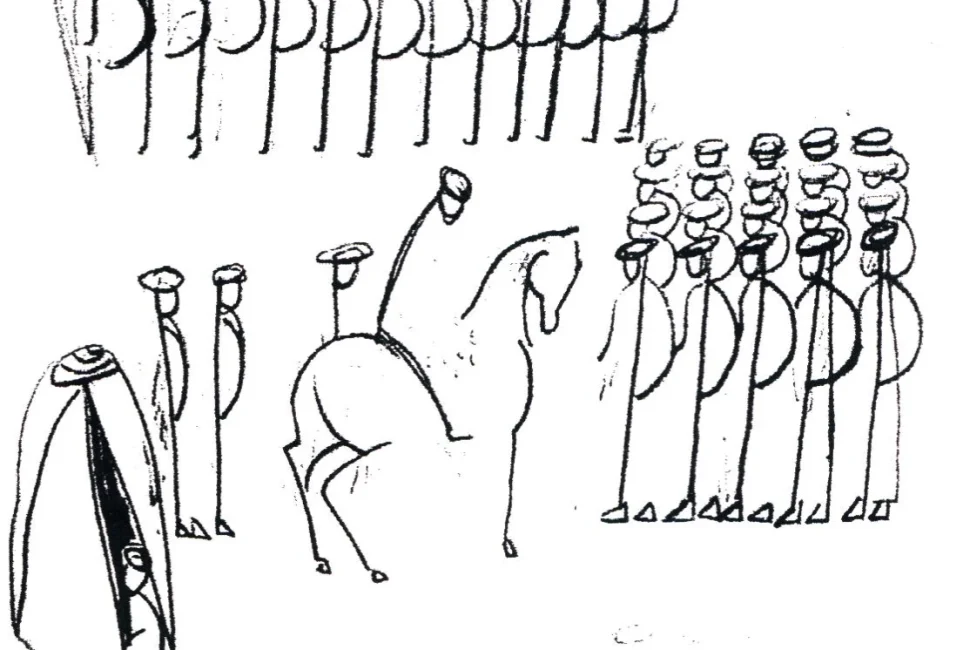
We see a kind of mold-breaking and liberation in Hessam’s latest works. As if he wants to break out of himself. But to where? His last drawings, which are charcoal on paper show subjects such as Namaz, Crucifixion, and Ashura with the same powerful emotional and passionate expression, reflecting his inner turmoil without any modifications. On the other hand, his large-scale oil paintings with everyday subjects such as wrestling and swimming in a pool which remained unfinished stay in contrast to the smaller compact collage works with subjects such as religious concepts and stories. The unfinished pool painting has the same simplicity of the process and naive tone that he previously tried in the painting of “Two Abyaneh Women”. In his religious collages such as Ashura, Archer, and Cave the subject and even the narrative are at the center of attention and the execution of the work is with elegance and reliance on the command over the tradition of painting behind glass and Iranian miniatures, but abstraction also goes so far as to a kind of minimalistic muteness. The large and small pieces of painting were probably cut from his previous paintings. The empty and flat backgrounds in the paintings and the smooth finish of the paint had replaced the thick exciting colors of the previous paintings, and simplified forms have taken over the passionate play of colors from the past.
All of this shows that Hessam never tried to artificially form his works. He was in the process of a profound transformation and wasn’t afraid of having different experiences to help him reach what he wanted to express. It’s a shame he did not get the chance to explore the new paths he had opened before him, but that doesn’t dilute the value of the works he did manage to create in his short life with passion and faith. May his name and memories live among the other great artists of our time.
فرم و لیست دیدگاه
۰ دیدگاه
هنوز دیدگاهی وجود ندارد.