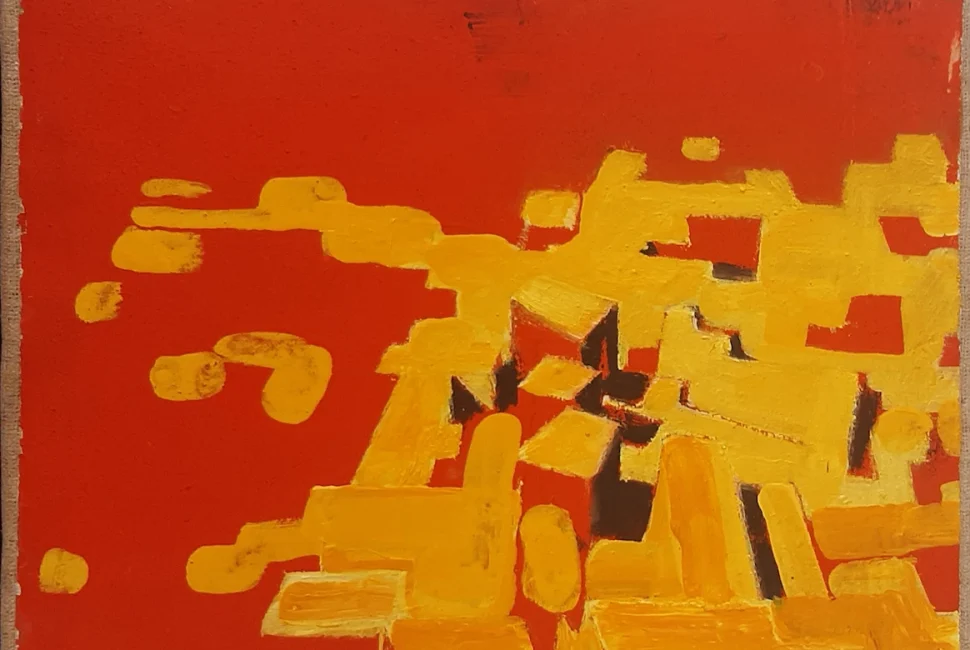
This is Abyaneh—I know it is. Although I have never personally been there, I have seen this dense arrangement of cube-like houses, stacked and rising upon one another, in films and photographs. My first encounter with the paintings of Hessam Rezaei was in Herfeh: Honarmand, Issue No. 7, published in the spring of 2004—six years after the painter’s death in 1998, at the age of 38.
Among the images printed in that issue, the Abyaneh paintings stayed with me, along with the thought that I would never again see any work by this young, prematurely lost artist. Abyaneh was a powerful image. I did not know why then, and I still do not fully know, but many times, when I heard the name Abyaneh, it was not the beautiful postcard-like images of its red earth that came to my mind, but these paintings. Something had fixed them in my memory—perhaps the directness of their forms and the strength of their monochromatic color.
Years passed. One morning in Shahrivar 1403 (September 2024), I entered SARAI Gallery. And this time, I also saw Hessam Rezaei himself: a self-portrait of a young man, with a well-formed, bony face and piercing green eyes staring at the viewer. Seeing the self-portrait gives rise to a feeling that is at once obvious and yet magical—that the painter is there; not merely because of resemblance; no. The brushstrokes, and the tangible presence of the movement of paint (which is the movement of the painter’s hand), preserve his body. This is the magic of the self-portrait: it shows both the artist’s likeness and interpretation of himself, and something more tangible and immediate—that he himself has painted himself. A trace of this lost “self” was there, looking at me.
I knew that I was about to view a large number of works by Hessam Rezaei up close—works that had been entrusted to the gallery by his family. Some of the paintings needed restoration; and many of the drawings and small color works were being kept in poor condition, at the bottom of cardboard boxes. The better-preserved pieces were arranged all around the gallery, and they were so numerous that one could almost grasp the entirety of Rezaei’s artistic career there; in a word: the space was filled with color—or more precisely, with chromatic energy.
We moved through the gallery, taking in the works from all around. The Abyaneh paintings were there, in their monochromes of red, green, and gray; yet they were surrounded by landscapes, caravanserais, arches, and windows. “Abyaneh” had a precedence and a following. These works could be situated within one of the principal patterns of Iranian modernist painting in the 1360s–۱۳۷۰s SH (1980s–۱۹۹۰s CE): that is, the translation of nature into a semi-abstract image with luminous colors—yet with bolder brushstrokes and a more compressed chromatic energy.
A little later, we opened the boxes of a Sony tape recorder, filled with works on paper and cardboard. These pieces had been kept by Rezaei’s family for years. As we went through them sheet by sheet, all the way to the bottom of the boxes, encountering increasingly personal and experimental works, it felt as though we were moving layer by layer into the psyche of an artist who had long awaited being opened up and seen—an artist who, just over there, was looking at us through his self-portrait.
A closer look at them revealed that Rezaei’s art was far more than a mere repetition of an artistic school or stylistic pattern from years past. There was a stronger, wilder force within his works—a force closely connected to his years of artistic study in Germany in the 1980s CE (1360s–۱۳۷۰s SH), when the “Junge Wilde” (Young Wild Ones) movement was active. Specifically, I saw paintings that established a more direct, freer, and intimate connection with the painter’s emotions: a kind of compression, a sense of suffocation, or liberation, joy, and courage. His “self” was insistently present there—a presence of the artist himself that breathed through the force of color and the unusual compositions in the space.
This freedom and immediacy is something that, for example, Rezaei’s longtime friend Ali Nasir would later demonstrate even more prominently in his works; another painter who lived and studied in Berlin during the same years. During that period, the vanguard of Berlin painting positioned itself against the mainstream currents of art—minimalism and conceptual art—and, in redefining painting, turned to vigorous, rough strokes with luminous colors and a liberated mindset in addressing subjects. This movement referenced early twentieth-century German expressionism, but with rougher, more spontaneous brushstrokes, and a reduced philosophical and introspective weight. Unlike the early-century expressionists, the concern of this movement was no longer to redefine a new “painterly language” in accordance with the ideals of modernist art; that goal had already been fulfilled. Instead, relatively young painters of this movement directly engaged in exuberant, explosive, aggressive, and unrestrained expression on the canvas. For an Iranian artist who had lived through the 1360s SH (1980s CE), this kind of free, individual expression offered a point of escape, a form of catharsis and liberation.
The importance of the “individuality of the artist” and “personal expression” is itself a kind of social outcome. In Iran, the emergence of individual tendencies in taste, expression, and appearance was a reaction to the heavy collectivism of the 1360s SH (1980s CE), which was both a legacy of traditionalism and of leftist, revolutionary fervor that had been kindled since the 1340s SH (1960s CE) and reached its peak during the Iranian Revolution. The 1360s SH (1980s CE) represented a practical test of life under such an ideal, and after the collapse of that ideal—not only in Iran, but globally with the fall of the Soviet Union—what remained was not the unity of a single life, but a multiplicity of lives gradually emerging from beneath the rubble. These sprouts did not grow naturally and freely; rather, they encountered opposing and suppressive forces that diverted their fragile path of development, making the passage through it far more arduous than it had initially appeared.
What emerged in Iran after the 1360s SH (1980s CE) was not a revolution aimed at overturning values. It was a movement pursuing reform, moderation, dialogue, the softening of sharp edges, and the poeticization and coloring of the concepts and processes that prevailed in Iranian society. Alongside this familiar narrative in politics and society, art was also undergoing transformation. Artistic media were stepping out of the shadow of social obligation and mission, experimenting with various modes of expression. The strongest evidence of the collapse of revolutionary ideals in visual art was the intellectual and practical shift of painters—some of whom had been pioneers of committed, revolutionary art in the 1350s SH (1970s CE)—away from their previous art toward semi-figurative, semi-abstract, symbolic, lyrical, mythic, and, in the broadest sense, more personal images. Although a sense of order and discipline remained, it stemmed from the concern of achieving a localized form of modernism. The key concepts of this painting were “mental agency” instead of direct imitation of reality, and the “authenticity of visual elements” or the expressive capacity of line, form, and color, which were directly related to the ability to “see abstractly.”
Thus, painterly modernism, combined with references to traditional art or a local-national atmosphere, became the defining model of painting in this period. It is within this context that Hessam Rezaei should be understood. He entered the Berlin Academy in 1368 SH (1989 CE), traveled regularly to Iran, and held his first exhibition at the Sabz Gallery in 1371 SH (1992 CE). During these trips, he visited Yazd, Kashan, and Abyaneh, and the local architecture of caravanserais began to appear in his works. Color in his paintings has a consistent inner quality, and this inner self reaches its fullest and purest expression when he depicts nature. He neither transforms nature into symbolic or romantic forms, nor remains strictly faithful to its outward appearance. His drive for chromatic expression is so strong that nature in his work dissolves into abstract images with dense, material colors. He begins with nature, but from the very start, color follows its own path, and interpreting his work requires a translation of the feeling of color.
This pure, abstract expression, when applied to local elements, withdraws slightly, and his works acquire an Iranian identity, approaching the painting model of the 1370s SH (1990s CE)—that is, a search for identity within the framework of Western modernism. Yet he avoids the reflective distance required to establish a uniquely personal style. In his work, one cannot observe the distinctive personal style achieved, for example, by Mehdi Hosseini or Nosratollah Moslemian. Fundamentally, he was not seeking to establish a comprehensive or “school-based” model for Iranian modernism. When engaging with his works, we see that the inner force of the painting so dominates the external forms that arches and domes of traditional architecture are buried beneath the colors; these elements are depicted with the same painterly intensity with which Van Gogh, Munch, and German Expressionists painted nature. He was not pursuing a “signature” painting style, but painted with a more general approach, and his primary aim was the direct translation of feeling into color.
Samila Amirebrahimi, in her article “Hessam Rezaei and the Trajectories of Iranian Art,” provides a description of Rezaei’s physical and mental condition: “He had a fragile and sensitive body and psyche” and “faced financial difficulties.” “In 1373 SH (1994 CE), he returned to Iran with the intention of permanent residence. Yet, after some time, facing professional and personal challenges, he wavered between staying in Iran or returning to Germany. The experience of holding three solo exhibitions in Iran—which, although not unsuccessful, fell far short of his expectations—the lack of adequate space to work, and perhaps a sense of loneliness and estrangement from the environment he had come to Iran for with such devotion, made him hesitant.”[۱]
The portrayal of Rezaei’s situation closely resembles the experiences of many young painters who begin their professional practice with enthusiasm, only to find that obstacles make continuing increasingly difficult. However, today there are far more galleries and art audiences, and more money flows in the art market overall. Hessam Rezaei embarked on this path in the early 1370s SH (early 1990s CE), at a time when neither a thriving market nor a significant artistic community existed, and one can deeply feel that this diligence—despite a society just emerging from war and revolution—required an extraordinary love for painting. This relentless fervor for work is not merely a sign of passion; it also stems from the therapeutic function of this kind of painting.
This persistent inner necessity and the unstoppable force of painting remain evident in his works even 25 years after his death. Since the nature of his painting is deeply personal, some of his most successful works can be appreciated beyond a chronological, retrospective view. He did not paint to connect to a particular artistic “style” or national movement, nor to reproduce a specific type of image like a production line. That is why, when I looked through the dusty archive of his works, with every sheet I turned, I anticipated encountering stranger colors, more inventive compositions, and renewed energy. His works, although they reflect the period, prevailing patterns, and contemporary sensibilities, nonetheless establish a direct connection with the viewer. It is for this reason that the Abyaneh paintings remained in my memory.
Interestingly, his final works were small figurative collages with religious and mythological narratives. This path is the opposite of the typical trajectory of painters, who often move from figuration and narrative toward abstraction. Whether this unusual turn was a lasting shift or a temporary divergence is unclear. Did his religious and mystical beliefs impart more color to his spirit? Did he, like many artists in the 1370s SH (1990s CE), search for spirituality in order to find something lost within the framework of traditional beliefs and miniature painting forms? We cannot answer these questions definitively, although it is possible to perceive that the “self” he sought individually in his painting could at times lean toward a “collective self.” Loneliness, anxiety, illness, and psychological or economic insecurity can lead this fragile, solitary self toward an imagined and comforting refuge within tradition.
The new story Hessam Rezaei had begun did not develop enough to allow for a meaningful interpretation. He passed away at the age of 38 in 1377 SH (1998 CE) due to a heart attack, and his short life did not allow his artistic trajectory to fully unfold. Nevertheless, the remaining body of work is sufficient to understand the portrait of an artist who painted with his very being. His self-portraits bear bright, calm eyes, behind which the surging energy of his fervent force forms another living portrait within the body of his works.
[1] Samila Amirebrahimi, “Hessam Rezaei and the Trajectories of Iranian Art,” Herfe: Honarmand, Issue 7, p. 167.
فرم و لیست دیدگاه
۰ دیدگاه
هنوز دیدگاهی وجود ندارد.