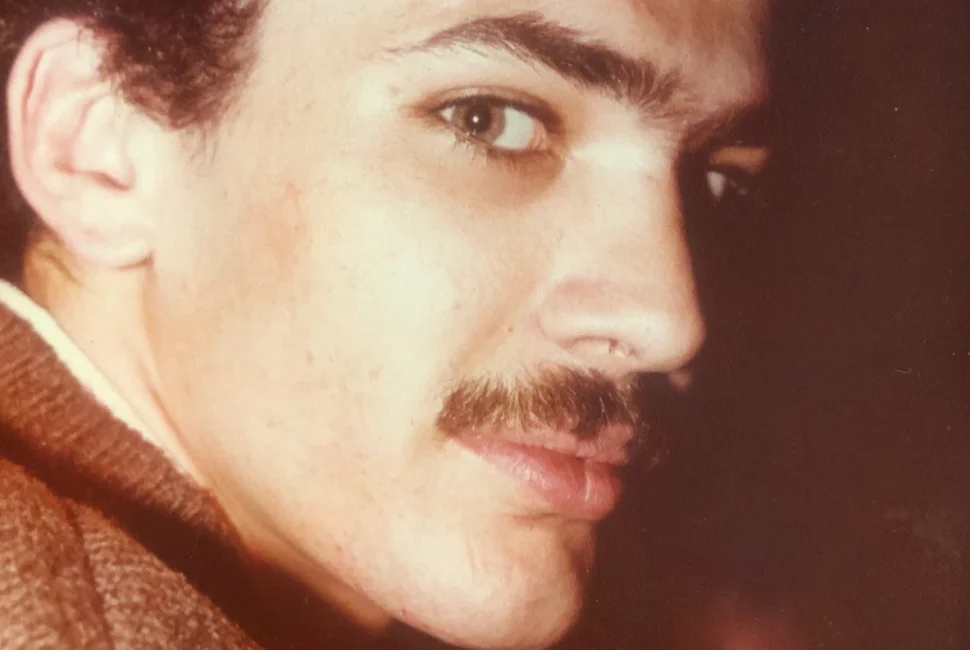
Nearly thirty years ago, perhaps at a time when Hessam was walking the cold corridors of the Berlin School of the Arts on his way to begin work in his vast, high-ceilinged studio, he may have paused for a moment—struck by an involuntary memory, or rather by a recurring thought that would from time to time occupy his mind. In that instant, a sun-drenched land might have appeared before him like a richly patterned carpet: a land where he had once wandered and come of age; a land through whose winding alleys he had strolled while dreaming of reaching this very school, and to which he now felt the desire to return—to those same alleys, under that same light. We always feel we are not where we ought to be: at home, we long for the dark forest; in the forest, for the narrow path that leads back home.
Yet in my view, such a preoccupation in Hessam’s mind went far beyond a simple longing for home and family. He possessed an inquisitive intellect, along with the intensity and tenacity essential to artistic practice. He was constantly searching for a solution to his artistic expression, and in striving toward it—consciously or unconsciously—he was drawn to a connection whose one end lay in the teachings of that school, his experience of Berlin, and his exchanges with German classmates, while the other reached back to the environment from which he had emerged: a milieu that offered him a different understanding of form, space, light, and proportion, articulated in a rhythmic and seemingly flawless harmony.
He often found himself thinking of Yazd, Kashan, and Abyaneh—places that, set against the Berlin of those years—a city rapidly modernizing, an open society marked by self-assured displays of architecture and art—appeared like elsewhere left behind by history: towns or villages hidden beyond dunes and salt flats, or nestled deep within a valley.
Hessam crossed the inevitable threshold all too soon, yet his experience in artistic practice was anything but youthful. If we were to stand together before some of his canvases, I imagine readers of these lines would agree that he could rightly be called a seasoned artist.
I do not find it easy to grasp the complexity of his works. Although he chose places in our own surroundings as the subjects of his paintings, his approach was shaped by an accumulated artistic tradition—one that had taken root elsewhere and which he pursued with persistence. Hessam’s effort was to find, at the threshold between two cultures, a site for his pictorial experience—arrived at through a reflective mode of observation. My task now is to approach, through words, the domain of that visual space.
I would like to begin by noting that the fundamental differences in how various artists represent the same object or event reveal that, over time, they have not viewed the subjects of life in the same way. Some artists, rather than reproducing something exactly as it appears, use the external world as a starting point for their sensory experience. In other words, by selectively engaging with elements of the outside world—and introducing shifts and modifications guided by their personal sensitivities and intentions—these artists give tangible form on the canvas to their inner feelings.
Primarily, artists approach subjects that resonate with their own thoughts and ideas, and naturally, they then shape and adjust these subjects according to their personal intentions and desires. As Otto Runge writes: “We seek an event whose qualities correspond to the feeling we intend to express, and if we find it, we have chosen the subject of art.” Such a subject may be the most ordinary and recurring scenes of everyday life. For artists, even a simple piece of cloth with a few objects and fruits placed upon it, whether in daylight or the dimmer light of an apartment, can become a repeatedly explored theme. Yet over time, we observe that the same subject has been transformed in strikingly different ways, reflecting each artist’s individual perception and finding its expression on the canvas. In some cases, this process goes so far that certain artists render only a faint echo or a subtle vibration of the object.
The historic caravanserais of Yazd, along with those in other desert regions, have stood as safe and tranquil havens amidst the chaos and fury of the surrounding nature—places grounded in rhythm and proportion, as if carrying an eternal melody to the attentive ear. Only when the simple interactions and occasional struggles of their inhabitants add a pulse for a few hours each day does the space gain movement; otherwise, the harmonious chambers of these buildings quietly and carefully receive light and shadow, embracing them with humility within the very substance of their material.
With masterful precision, these spaces break the streams of light and shadow, chamber by chamber, so that in the corners of the courtyard the rhythm passes to another edge. In this way, time and space seem to take on a form confined within the unadorned earthen material of these places. Each side of the courtyard gains its own character according to the movement of light, prompting those who dwell within this contained realm to shift and move—much like we move through the interplay of light and shadow in the spaces of our brief lives.
These caravanserais became the focus of a substantial and sustained series of Hessam’s drawings and paintings, and naturally, he perceived these places through the lens of his own awareness and the particular temperament of his psyche. In the works from this period, he was neither interested in producing a documentary record nor in creating a strictly mimetic depiction of the structures, nor was he primarily concerned with capturing the climatic qualities described above. Rather, his images reflect a different mode of seeing—a new approach that painters have pursued with intensity since the nineteenth century. Situated at the intersection of two cultures, Hessam used some of their most fundamental explorations as the foundation for his own artistic experimentation.
As noted earlier, some artists, when taking an object as the starting point of their artistic exploration, aim to deepen their sensory experience through it. In other words, they seek to pass the object through the lens of their consciousness and psyche, blending their perceptual and existential vibrations with it to enrich their felt understanding of reality. In this process, Hessam focuses on an aspect or quality of the places before him that resonates with his own sensibility and vision. From that moment, he takes command of the image, introducing changes in composition, color, and the conventional use of perspective. What is the nature of these transformations? What path do they carve for his images, and ultimately, what meanings do they bring onto the stage of his art?
At the outset, it should be noted that the thick impasto in Hessam’s canvases lends itself to several aligned readings. These dense patches of paint, by virtue of their physicality, first and foremost remind us that the painter is engaged in a direct struggle with tangible, material reality, giving little weight to distant, elusive, or purely imaginative ideas.
At the same time, the expansive presence of these heavy surfaces and pigment-laden passages carries within it the expression of the artist’s stirred emotions—colors that become one with his voice, even with his cry. Through such dense applications of paint, the ominous quality of shadows is intensified alongside luminous surfaces—surfaces that, although they stand for light, evoke a sense of unease due to their roughness and stark immediacy. These shadows are at times produced through complementary colors, and at others through subjective ones—namely black and a spectrum of greys.
Another point that should be addressed is his departure from geometric perspective and his turn toward a lived perspective—or at times even an abstracting one—which initially emerged as a preoccupation and later came to function as a necessity in the modes of seeing pursued by painters since the nineteenth century.
Drawing on this approach, Hessam, through a sensory awareness of distance and proximity—through a free engagement with those aspects of reality whose presence he feels—selects, gathers, and at times exaggerates and interweaves them within a compressed and tense spatial depth. Unconcerned with the meticulous rendering of outlines or the subtle seductions of visual stimuli within his scene, he seems to draw the external world closer to the realm of his senses. In this way, the outer world, having passed through the painter’s inner being, returns to us like a reflection born of the encounter between the artist’s nerves, temperament, and psyche and the scene before him.
What results from such an encounter does not accommodate fine detail, nor does it yield to closure or certainty. It follows, then, that such work cannot satisfy those who expect from a work of art a sense of totality and, consequently, a finished polish—even when the painter turns to places whose firm lines and solid planes appear, in themselves, to embody richness and completeness.
In Hessam’s images, the caravanserais, with their intense density, evoke the sensation of confronting a vast yet restless room—a sense of an enclosed, roofed space in which the field of vision gathers and contracts, as though the eye had momentarily taken refuge within a small, trembling frame. In these canvases, the courtyard—with its rows of columns, rhythmic chambers, and window frames—appears as a unified whole: a still totality that is nonetheless unsettled, as order and disorder continue their tension within the painter’s frames.
By reducing the narrative weight of things, compressing perspectival depth, and disrupting conventional arrangement and compositional order, the painter seems to pursue an ever-closer approach to the experience of reality. It is the very same pursuit that haunted Cézanne so persistently—what Émile Bernard described as Cézanne’s “suicide”: “to aim at reality while denying oneself the means of attaining it.”
As noted earlier, Hessam’s work was not a purely sensory, unmediated experience of the familiar, entirely independent of the external world. Rather, he sought to bring an emotionally charged contemplation into contact with the visual stimuli of the outside world—to fuse his inner intensity with the external object and reflect the result of this encounter on his canvas.
Whether working beneath the cascading rays of sunlight or in his studio, whenever he senses that the force of unified surfaces is driving his image toward abstraction, he reintroduces planes of color and lines suggestive of the walls, chambers, and columns of the caravanserai—yet within a markedly shallow depth, beneath a closed sky and above an almost empty ground. However, since his external object (here, the caravanserai), with the rhythmic cadence of its chambers and its measured structural order, does not readily yield to such emotional intensity, he often finds himself in tension with the outer world. This tension is evident in the dense, loaded brushstrokes, in the thick lines and surfaces that, though intended to stabilize the image, remain vibratory and seem inclined to overturn the scene before us—to unsettle the familiar arrangement of things, to introduce a kind of suspension favored by abstract painters (at times, the orientation of the caravanserai in the image becomes difficult to discern).
The pulse and latent tension embedded in the chromatic passages and columnar lines of his canvases seem to summon the mind to a theatrical stage: an animated performance in which these expressive, living lines and surfaces appear to engage in a dramatic dialogue—a dialogue of vivid, resonant colors that the painter, in depicting the caravanserais of Yazd, has set in place of brick, clay, and mortar.
After viewing both the smaller and larger paintings of Hessam, one experiences a sense of ease upon turning to the works of Ali-Mohammad Heidarian. What is the source of this comfort in Heidarian’s paintings? In these images, there is neither a struggle between line and color, nor the presence of themes that lay bare the conflicts of life or the dark depths of the human psyche, nor that kind of experimentation in the language of painting that seeks to move beyond the surface of things in order to approach an almost revelatory, unmediated understanding of reality.
The canvases of this painter belong to a realm of ease and composure—a tranquility that is, at its core, discreetly concealed; for contrary to what they may seem, they tend to veil reality rather than reveal it. In this way, ordinary things and everyday events take the place of the soul’s strenuous labor to grasp the unattainable reality, so that unrest is withheld from our eyes and minds.
This, though not identical, recalls what Cézanne once said of the old masters: “They have replaced reality with imagination and the abstraction that accompanies it.” By contrast, Hessam’s paintings leave us restless. In his work, reality seems to settle behind the eyelids rather than in the open eye, and it is this very quality that lends his paintings a dark and ambiguous tone—a darkness that nonetheless reaches us through piercing, luminous colors.
Within this field of experimentation, he suspends the clarity, material presence, and fixed place of the object. In turn, his charged patches of color impart just the degree of emotional intensity required to awaken the mind, to disrupt habitual ways of seeing, and to open onto a deeper apprehension of reality—especially as Hessam inscribes such intensity into the measured rhythm of structures that themselves affirm reality, buildings in which, once, errant and chaotic rays of light were brought into the order of form.
And what might be said, if a certain tension—whether slight or intense—left behind from the encounter between psyche and place, is itself one of those very drives the mind requires in order to once again apprehend the reality of such spaces?
It must be said that Hessam stepped into the world of painting amid the rise of a new understanding of art, and in his effort to grasp this knowledge and its intricacies, he never took a sidestep. This understanding, observable through his images and accumulated on the pages of his sketchbooks, represents a body of artistic experience in which reality is no longer a mere copy or mimetic reflection of the external world. Instead, it emerges as an indivisible whole, where the meaning of the painted object—let us call it the artwork—and the meaning of the world converge at their boundaries.
As the tenor of this text suggests, my focus is primarily on Hessam’s approach to reality: how, in this context, he challenges the tangible. By “tangible,” I refer to the objects we encounter in daily life, the places we visit, the qualities in which we immerse ourselves, and ultimately, the way we weigh their relationship to our own consciousness.
Apart from the village of Abyaneh, which master could have spared the young painter from that grueling struggle—the struggle of chamber against chamber, of light against shadow, of the edges of that quadrilateral of a harsh life beneath the sky? Abyaneh suddenly, almost entirely, unfolds before the painter’s eyes. In Hessam’s early studies, the region appears as an expanse of cracked earth beneath the sun’s veil. Gradually, red earth and red pigment merge, and a slanting red light reveals the geometry of this fragment of land—a chaste geometry that seems to contain body-like, rhizomatic shelters within its core.
Yet the subject of the painting only modulates the painter’s emotional fluctuations to a certain extent. In these canvases, too, there is no horizon or open sky above the landscape—an element whose symbolic weight might otherwise lend the foreground a metaphorical significance. During this period, Hessam kept his frames as enclosed as possible, preserving the inner heat of the image, even when in some works a layer of unrestrained, high-energy color occupies the space of the sky.
In Hessam’s paintings, we confront only what presents itself to our gaze; in other words, these objects—oscillating between thingness and mere patches of color—do not point toward what is unseen. In my view, any search for an invisible aspect in Hessam’s work could be seen as contradicting his own endeavor.
Once again, I return to Merleau-Ponty on Cézanne, who wrote: “He did not intend to distinguish between the stable things we see and the unstable path along which they appear. He wished to display matter precisely as it takes form…” This delicate boundary is where artists—at least those who have not forsaken observation in favor of purely intellectual speculation—reside. In Hessam’s work, this very intersection of observation, perception, and feeling gives rise to a kind of ambiguity, which here I wish to call a “force”—a force that manifests in his paintings as a vibrant, chromatic rhythm.
At the beginning of this essay, I noted that the painter has not been particularly concerned with capturing regional or climatic characteristics. The arrangement of straight and curved lines and surfaces in the architectural structure of the caravanserai, more than anything else, conveys the quality of metric music. In this sense, one might liken the rhythm of the caravanserai to a chahārmezrāb—a form in Iranian music structured around the pāyeh (a simple pattern that is continuously repeated) and the vākhān (one or more notes that are persistently played between iterations of the base pattern).
Examining the relationship between such a form—traces of which can be found throughout Iranian arts—and the notion of climate is a line of inquiry that lies beyond the scope of this essay. For now, it suffices to note that, in many cases, climatic characteristics play a significant role in shaping how arts with shared features emerge within a region and endure across centuries. The form and content of Hessam’s works suggest that he, at least from the perspective outlined earlier regarding the features of the caravanserai, as well as the points just discussed, has not paid particular attention to climatic qualities.
As noted earlier, Hessam was an impassioned observer who could not fully submit to such metric spaces and was always intent on filtering the external world through his restless mind… Yet, it must also be acknowledged that, in the act of painting, he stands in a specific place, selecting a subject from his own vantage point and bringing it into the frame.
One might say that the object of his work—whether the enclosed caravanserais or the village landscapes—absorbs the tone and temperament of the painter’s inner dispositions. The difference, however, is that in the caravanserai paintings, the artist’s physical proximity to the object, combined with the solitary and enclosed nature of these spaces, leads him to experience it as closer to both his body and psyche. As a result, these canvases are more tense and charged than the village landscapes.
The evident presence of this meaningful difference in his work suggests that, while painting, the artist maintained a keen awareness of his observational position—a point that is inseparable from what might be called the painter’s “being in place.”
On the other hand, as noted earlier, one of the defining features of Hessam’s vision is his simultaneous observation and apprehension of the hidden continuity between objects, presenting it in his paintings as a unified whole—a whole that, at its core, is turbulent and prone to breaking its prescribed boundaries. In his canvases, we witness the freedom of objects and colors to shift in form and position; yet this freedom is contingent upon the artist’s perception and feeling of the “environment,” rather than being entirely unrestrained.
Hessam—except for brief periods of hesitation—did not allow unmediated fantasy or overtly imaginative scenes and icons to dominate his artistic practice. The results of those moments, in any case, lack the maturity and contemplative depth of his other works, and are not the focus here. As mentioned at the outset, in his major works he sought to integrate the external world into his sensory experience, but never through a closed or dogmatic mindset that might obstruct the emergence of new pictorial possibilities.
In some paintings, we see form, color, scale, and the depth of the observed landscape increasingly subjected to displacement and modulation. In these instances, one senses that the painter, while maintaining a pulse drawn from the environment, allows himself greater freedom—thus offering us, from one perspective, more daring images. In one canvas, the blue of the sky collapses into the earthy rhythm of the caravanserai; in another, the green of nearby groves advances, completely enveloping the village’s red soil in a green shroud. Here, the painter’s strokes are more fluid and tranquil, and the earlier dramatic dialogue gives way to a more even tone—like the quietly alerting murmur of a half-shadowed meadow.
Last month, I visited a place where I was to see Hessam’s works again, in order to write a note about them. His small-scale paintings rested safely and undisturbed at the bottom of cardboard boxes. A feeling mingled with both longing and sorrow swept over me—it felt like a reunion. A faint scent of paint and turpentine drifted through the air. I thought to myself: Hessam has crossed that inevitable threshold—yet what is this color, what is this sound, that refuses to end…
۱. HDK: Abbreviation for Hochschule der Künste (University of the Arts) in Berlin. In 2001, the name was changed to UdK (Universität der Künste, Berlin University of the Arts).
2. See: Moshe Barasch, Theories of Art, Vol. 3, trans. Mohammadreza Abolghasemi, Cheshmeh Publications, 1401 [2022/2023], p. 76.
3. See: Maurice Merleau-Ponty, “Cézanne’s Doubt,” trans. Mehdi Salimi, available at: www.mindmotor.info
4. Ibid
5. Ibid
6. Refers to music characterized by a fixed, regular rhythm.
فرم و لیست دیدگاه
۰ دیدگاه
هنوز دیدگاهی وجود ندارد.